Navigation
Evermusic offers an intuitive user interface that closely resembles the native Music app. What sets it apart from many popular music apps is its built-in file manager, giving users the power to edit audio files and seamlessly transfer them to and from cloud storage.
Evermusic’s functionality is thoughtfully divided into two distinct components: the Music Library, conveniently accessible through the “Music Library” and “Playlists” tabs, and the Files section, found under the “Connections” and “Local Files” tabs.
Sections
Whether you’re using an iPhone, iPad, or compact mode on a Mac, all app features are easily accessible through the tab bar at the bottom of the screen. For iPad and Mac users, the same menu can be found on the left side of the screen. This thoughtful organization categorizes all app features into easily accessible sections, ensuring a user-friendly and efficient experience.
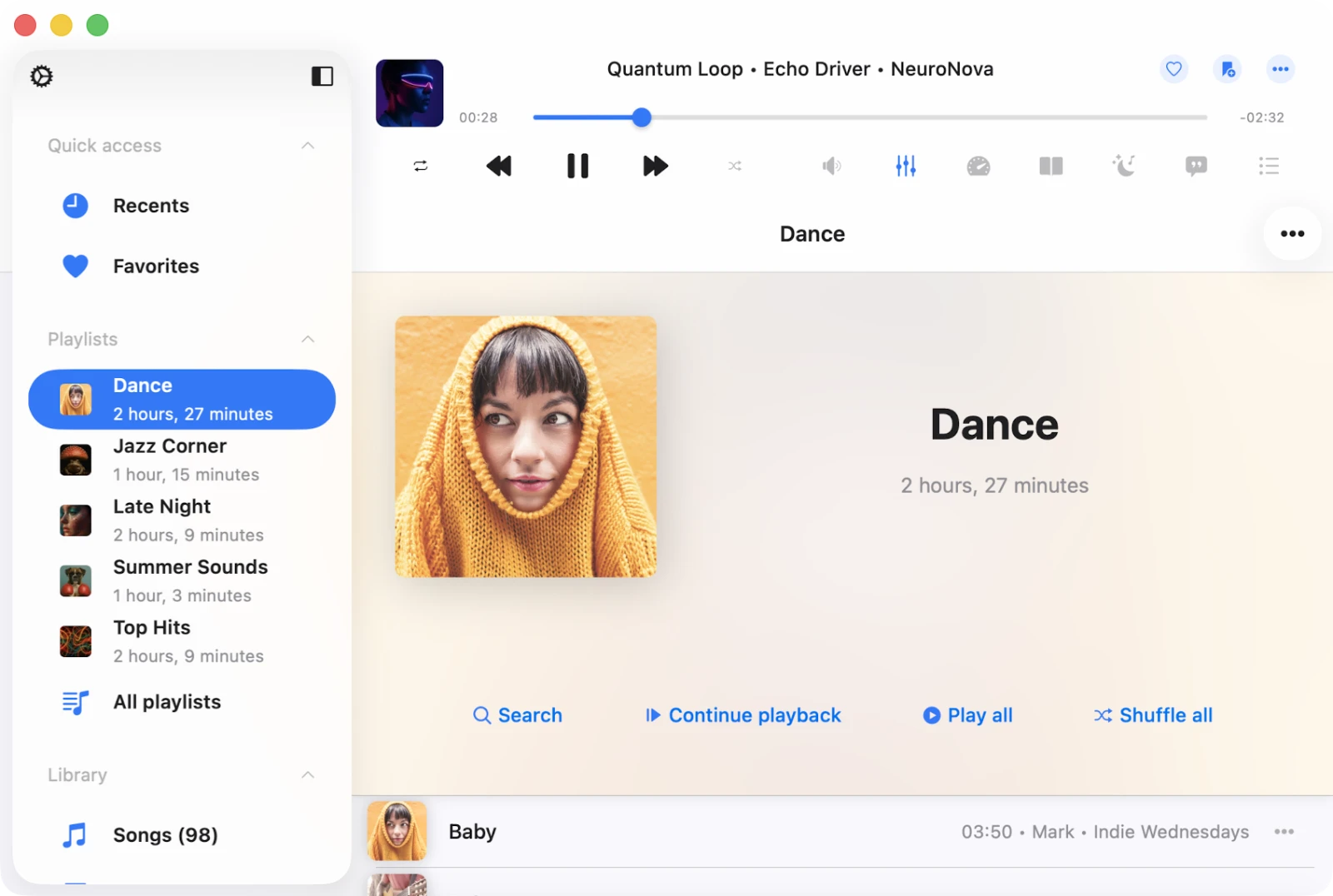
Connections: You can effortlessly connect cloud storage services such as Google Drive, MEGA, OneDrive, and Dropbox, as well as your computer and personal NAS on this screen.
Playlists: Manage all your playlists here, where you can create, edit, remove, change song orders, enable offline mode, and add songs to the player queue.
Library: This section neatly displays all available tracks, grouped by Artist, Genre, and Album. You can manually or automatically add songs to your music library, and it includes iPod tracks and downloaded music.
Local Files: Effortlessly locate and oversee your downloaded files, complete with control over the transfer queue. You can edit these local files using a range of file management actions. To access the transfer queue, tap on the spinning arrows icon found at the top left corner of the ‘Local Files’ screen.
The local files section is divided into two categories: Files in this application, displaying local files within the application’s Documents directory, and Files on this iPad/iPhone/Mac, revealing local files located on the device but outside the application’s Documents directory.
Settings: Modify application settings, including popular options like crossfade playback, music library sync, player cache, album artwork cache, user interface, and localization.
Quick Access: Seamlessly navigate to your favorite and recently played tracks and files. For Mac and iPad users, a dedicated section is available, while iPhone users can conveniently find them within the ‘Local Files,’ ‘Connections,’ and ‘Music Library’ sections located at the top of the screen.
Mini Player on iPhone
Activate a full-screen player by tapping the mini player icon and using a swipe-down gesture to hide it. On iPad and Mac, the mini player screen is located at the top of the screen and can be hidden when opening the full-screen player via the main menu.
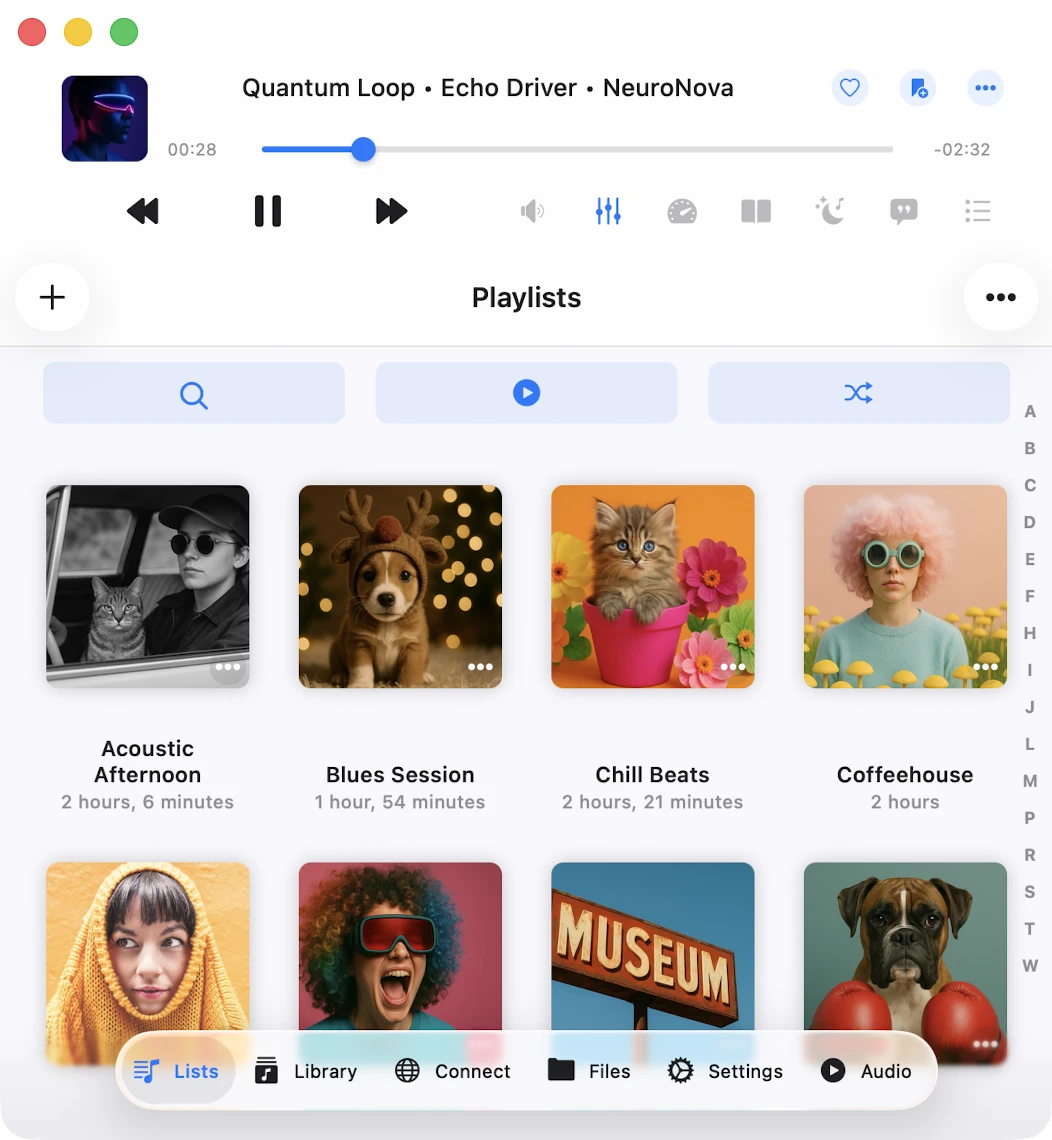
Mini Player Window (Mac Exclusive)
To access the mini player window on your Mac, simply move your cursor to the bottom-right edge of the app window and resize it to the smallest possible size. Then, tap the collapse button (depicted as a downward arrow) to activate the mini-player window. To keep the mini player window always on top of other windows, navigate to the top menu bar of your Mac, select ‘Window,’ and then choose ‘Show Window Always On Top.’ This feature is useful for listening to audio lectures without interruptions.
More Actions
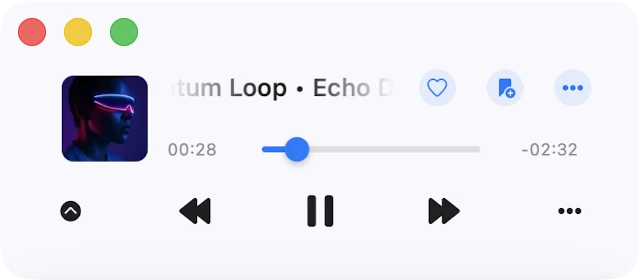
Virtually every content item on the screen features a “More Actions” button. Tap it to access all available actions.
Top Toolbar
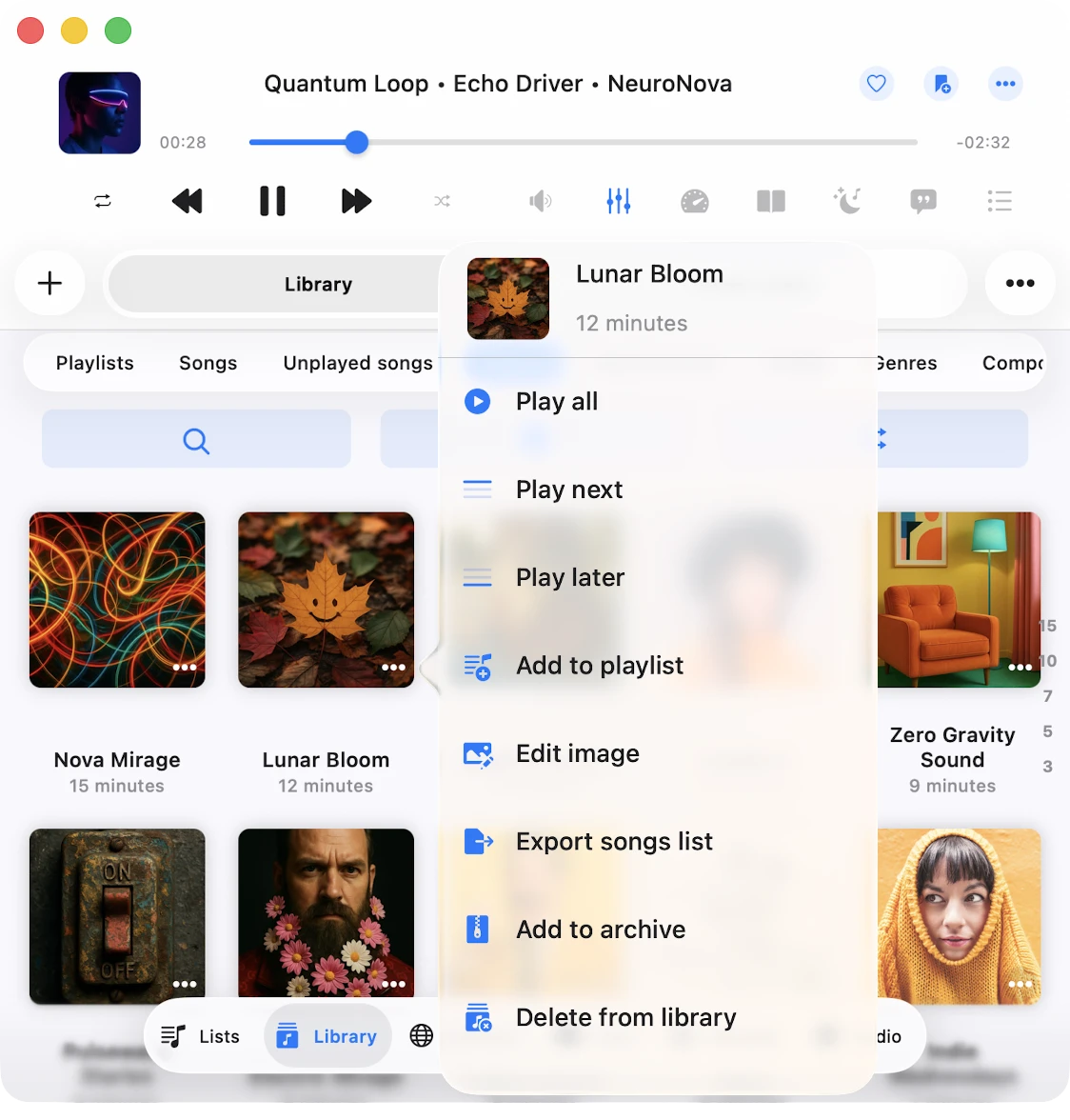
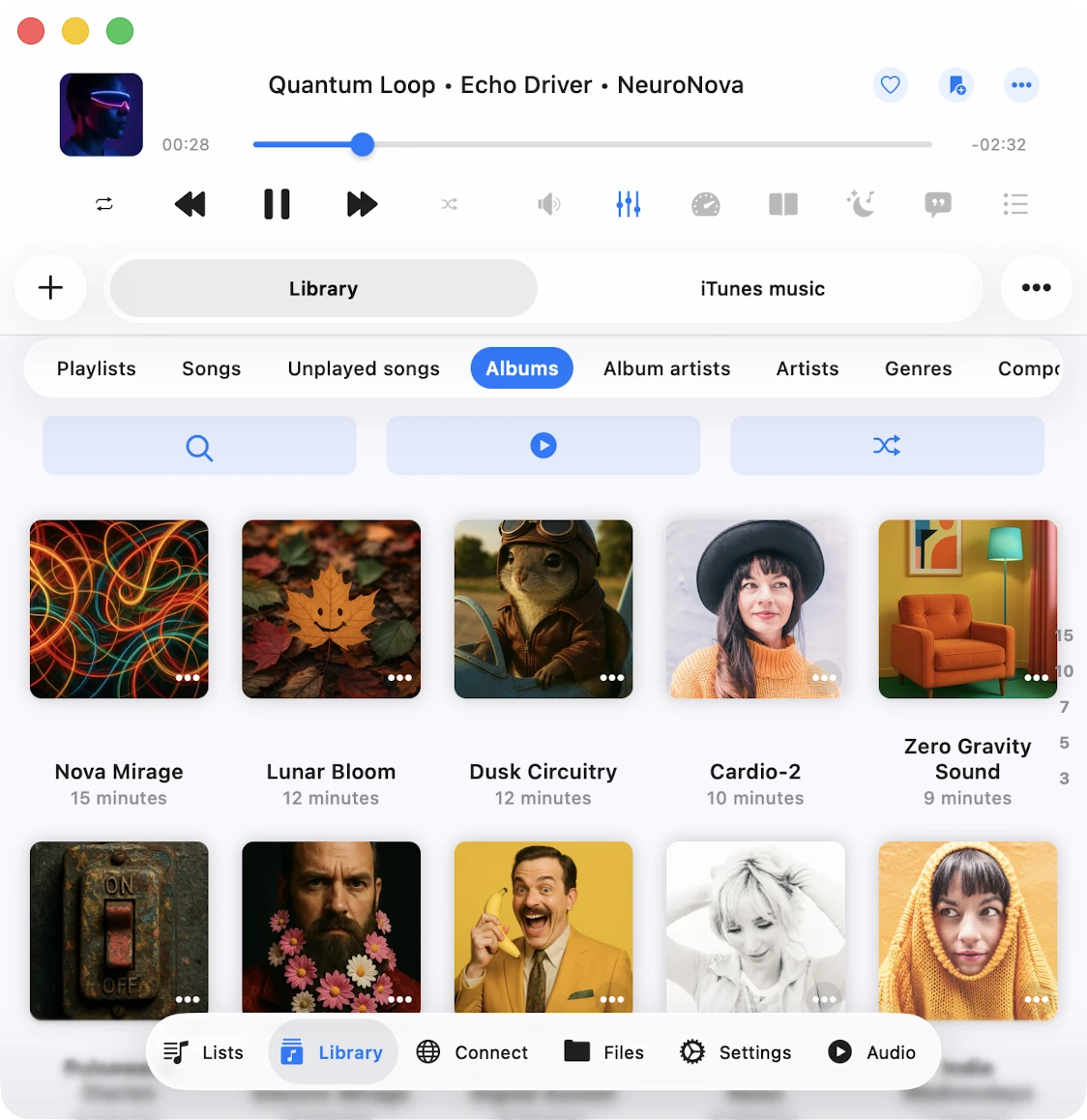
The top toolbar, situated conveniently just beneath the navigation bar, provides quick access to several useful actions.
You can easily reveal or conceal this toolbar with a straightforward swipe-down gesture. Here is a list of the actions.
- Search: Begin a search within the current context.
- Continue Playback: Evermusic offers a seamless ‘Continue Playback’ feature, designed to effortlessly restore the audio player’s state for the current directory, album, artist, or playlist from the last saved position. This functionality is available if enabled in the application settings.
- Play All: Easily add all tracks from the current page to the audio player queue, maintaining the current sort order.
- Shuffle All: Add all tracks from the current page to the audio player queue, shuffling them before adding for a delightful listening experience.
Context menu
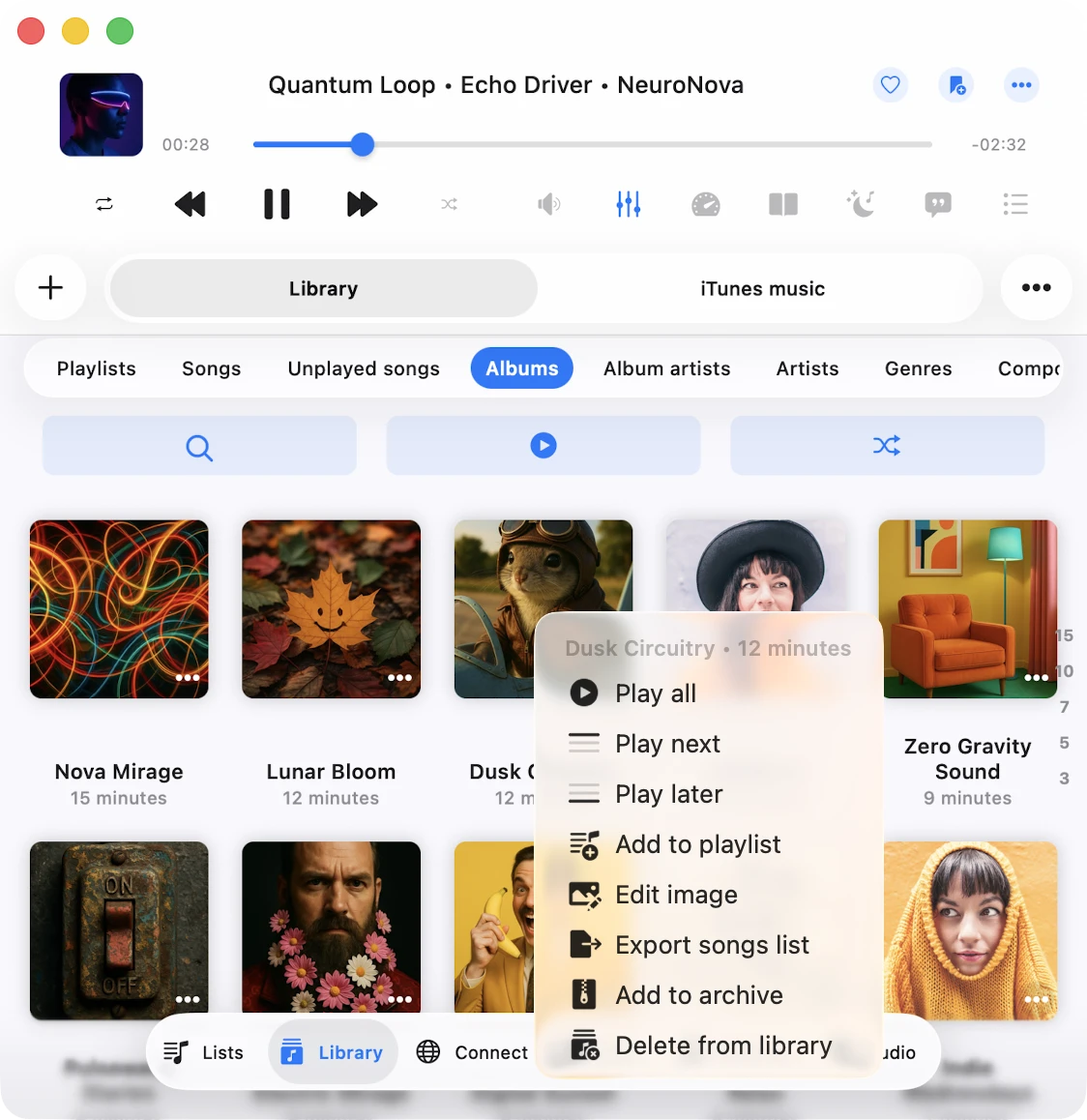
Context menu provides quick access to additional options and actions for seamless interaction across devices.
Context menu on iOS
Tap and Hold: Tap and hold on cells, the mini player, or the compact player to reveal the context menu.
Context menu on macOS
Right Mouse Click: Right-click on cells, the mini player, or the compact player to show the context menu.
Accessibility
Our app is fully accessible with VoiceOver technology, ensuring every component has a well-designed label and description. When VoiceOver is active, the app translates the user interface to text mode, displaying only accessible and useful elements to improve navigation speed and convenience. You can also activate text mode in Settings > Accessibility > Text Mode.
For adjusting sliders with VoiceOver
- Select the Slider: Swipe left or right until VoiceOver announces the slider.
- Adjust the Value: Double-tap and hold the slider, then drag up or down to adjust the value more quickly. VoiceOver will announce the new value as you adjust it.
For adjusting track position in a playlist with VoiceOver
- Open a playlist and tap the “More” button.
- Select “Change Songs Order.” The view will switch to editing mode.
- Tap the reorder indicator icon near the track title to give it focus.
- Double-tap the reorder indicator icon quickly. On the second tap, do not release your finger—hold it until you hear a sound indicating the cell is ready to be moved.
- Now, you can move the cell to a new position.
Other components work as expected, using system-provided VoiceOver patterns.
Widgets
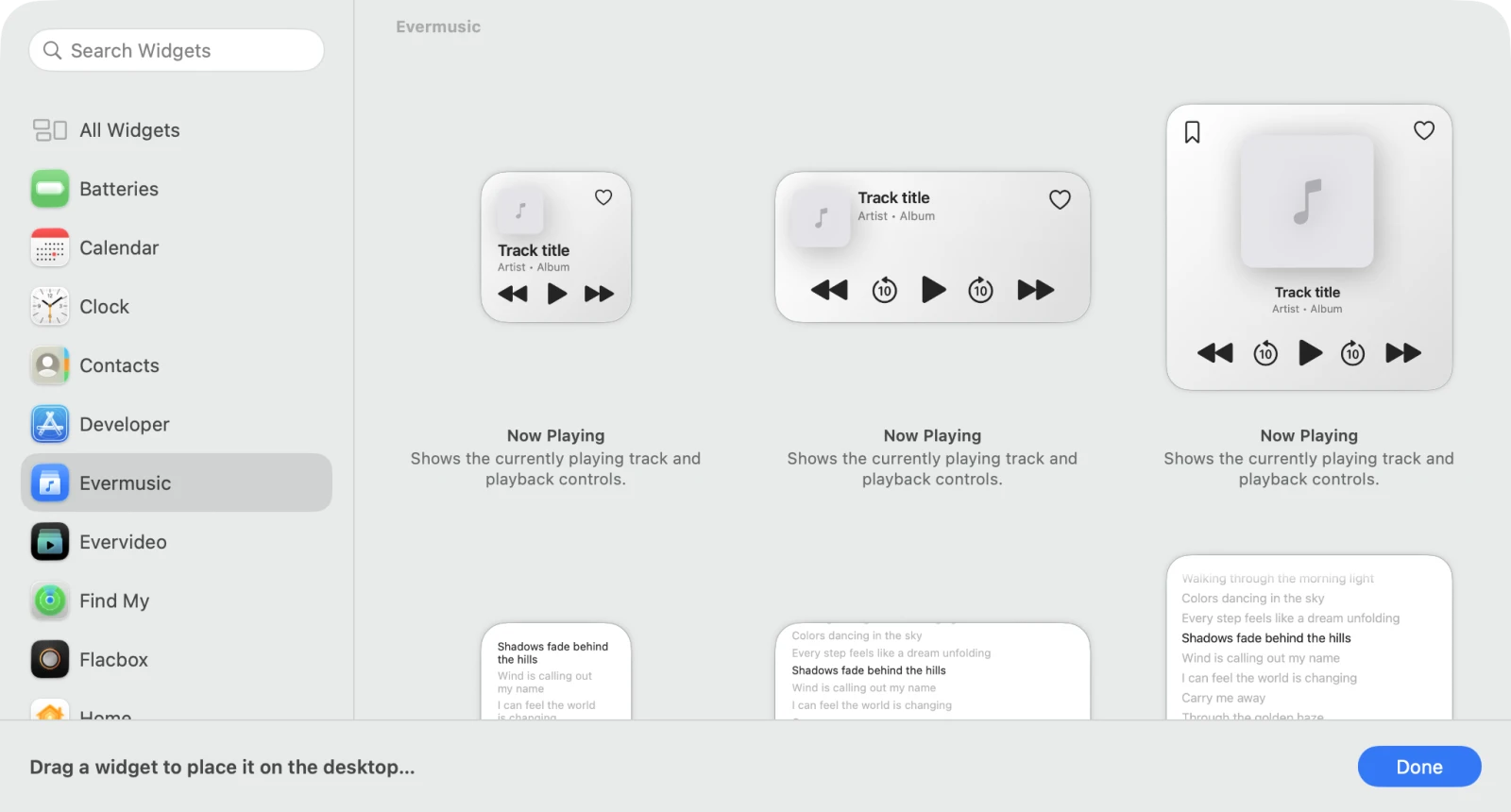
Evermusic ships with four Home Screen / Lock Screen widgets that surface key parts of the app on every Apple platform — no need to open Evermusic to see or control playback:
- Now Playing — current track artwork, title, artist, and live playback controls (play/pause, next, previous). Updates in real time as the queue advances.
- Favorites — your starred songs at a glance. Tap an entry to open it straight in the player.
- Lyrics — the lyrics of the currently playing track (embedded or LRC), scrolling line-by-line in larger sizes.
- Recently Played — quick access to the songs you played most recently, with one-tap resume.
All four widgets are available in Small, Medium, and Large sizes so you can pick the layout that fits your screen.
Add a widget on iPhone (Home Screen)
- Touch and hold any empty area on the Home Screen until the icons start jiggling.
- Tap the + (Edit) button in the top-left corner, then tap Add Widget.
- Search for Evermusic (or Evermusic Pro) and tap it.
- Swipe left/right to choose between Now Playing, Favorites, Lyrics, or Recently Played, then pick a size (Small / Medium / Large).
- Tap Add Widget, position it where you want, and tap Done.
Add a widget on iPhone (Lock Screen)
- Touch and hold the Lock Screen until Customize appears, then tap Customize → Lock Screen.
- Tap the widget area below the clock and pick Evermusic from the list.
- Choose the widget and tap Done → Set as Wallpaper Pair (or Set as Current Wallpaper).
Add a widget on iPad
iPad supports both Today View widgets and Home Screen widgets:
- Touch and hold the Home Screen until icons jiggle.
- Tap + in the top corner → search for Evermusic → pick a widget and size → Add Widget.
On iPadOS 15+ you can also stack multiple Evermusic widgets vertically to swipe between Now Playing, Favorites, and Recently Played in the same slot.
Add a widget on Mac
- Right-click on the Desktop (macOS Sonoma or newer) and choose Edit Widgets, or open the Notification Center and click Edit Widgets at the bottom.
- Search for Evermusic in the widget gallery.
- Drag a widget to your desktop or Notification Center, pick a size, and click Done.
Add Evermusic widgets to the CarPlay dashboard
Starting with iOS 17, CarPlay supports compatible Lock Screen / Home Screen widgets directly on the CarPlay dashboard (the multi-tile screen with maps, calendar, and now-playing). Evermusic widgets show up there automatically once they’re installed on your iPhone:
- On your iPhone, add the Evermusic widget to a Lock Screen layout (Customize → Lock Screen → widget slot → Evermusic) as described above. The same widget instance is mirrored to CarPlay.
- Connect your iPhone to your car via USB or wireless CarPlay.
- On the CarPlay screen, tap the Dashboard icon (the four-tile grid) in the bottom-left corner.
- Tap and hold any of the dashboard tiles to enter edit mode, then tap + on the tile you want to change.
- Pick Evermusic from the list of available CarPlay widgets and choose Now Playing, Favorites, Lyrics, or Recently Played.
- Tap Done — the widget stays pinned to the dashboard for every future CarPlay session.
The CarPlay widget updates live as your music changes and is large-fingertip friendly so you don’t have to look down at the car screen while driving.
Apple CarPlay
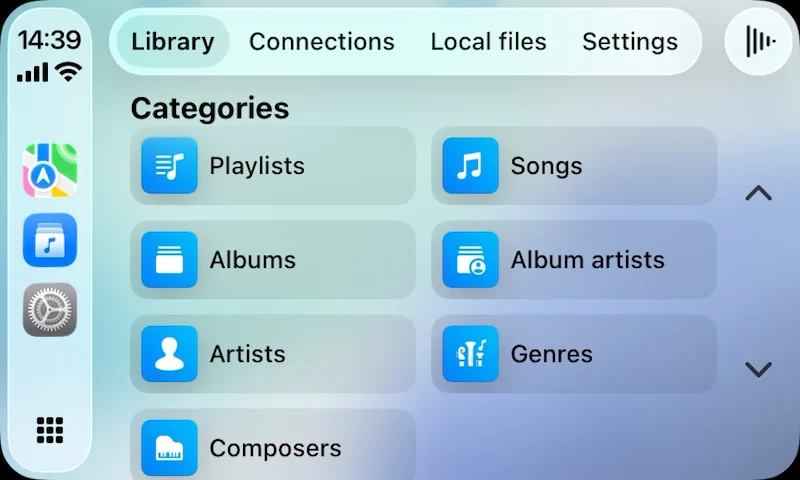
Evermusic includes a fully-featured Apple CarPlay interface (iOS only) optimized for the car display. Once your iPhone is connected to a compatible CarPlay head unit — over USB or wirelessly — Evermusic appears alongside Apple Music and Spotify in the CarPlay app grid, ready to stream your cloud library on the road.
What you get in CarPlay
The CarPlay UI mirrors the most-used parts of your library in a layout Apple has tuned for the car. From the main menu you can browse:
- Library — Songs, Albums, Album Artists, Artists, Genres, Composers, Recently Played, Favorites.
- Playlists — every playlist you created or imported (including offline-synced playlists).
- Local Files — folders in the app’s Documents directory and your Offline Folders.
- Connections — your connected cloud accounts so you can pick a song straight from Google Drive, Dropbox, iCloud Drive, MEGA, Synology, or any other source while parked.
Every track plays through Evermusic’s full audio engine — including the 10-band equalizer, crossfade, gapless playback, spatial audio, and playback-speed control — so the music you hear in the car sounds the same as on your phone, with no extra setup.
Now Playing template
The standard CarPlay Now Playing template gives you the steering-wheel-friendly controls every driver expects: large artwork, Play / Pause, Previous / Next, scrubber, and an Up Next queue. You can also enable Add Bookmark and Add to Favorites for the Lock Screen / CarPlay action set in Settings → Audio Player → Personalization → Playback Controls on the Lock Screen so you can star tracks without taking your eyes off the road.
Safe-driving tips
CarPlay is designed to keep your attention on the road — and Evermusic follows the same principles. Use these habits to stay safe:
- Pre-build playlists at home. Browsing dozens of albums on the road is distracting. Make a few “drive” playlists in advance and enable Offline mode on each so they play even with no cell signal in tunnels and rural areas.
- Enable “Pause playback when connected” in Settings → CarPlay → Pause playback when connected. This stops Evermusic the moment CarPlay attaches so you don’t get a sudden volume blast from headphones-era levels.
- Use voice control. Press the voice command button on your steering wheel or say “Hey Siri, play my Drive playlist in Evermusic” — Siri Intents support means you can start playback, skip tracks, and adjust volume without touching the screen.
- Pin a Now Playing widget to the CarPlay dashboard (see the section above) so you don’t have to open the full app to pause or skip — most actions are one tap from the dashboard.
- Lower the metadata reader speed. If you’re on cellular data with a large library, set Settings → Music Library → Metadata Reading to Current Song so the app doesn’t pull thousands of cloud requests in the background while you drive.
- Disable images in CarPlay when your library is huge. Settings → CarPlay → Show images → Off keeps the lists snappy on slower head units and reduces visual clutter.
- Don’t read the Lyrics widget while driving. It’s safe at a red light or with a passenger, but otherwise keep your attention on the road and listen instead.
If something looks off during a drive, the safest fix is always to pull over and use the iPhone directly — don’t fiddle with the head unit at speed.